Goat protection dogs - Il Pastore Transumante
A Complete Guide to Goat Guarding Dogs
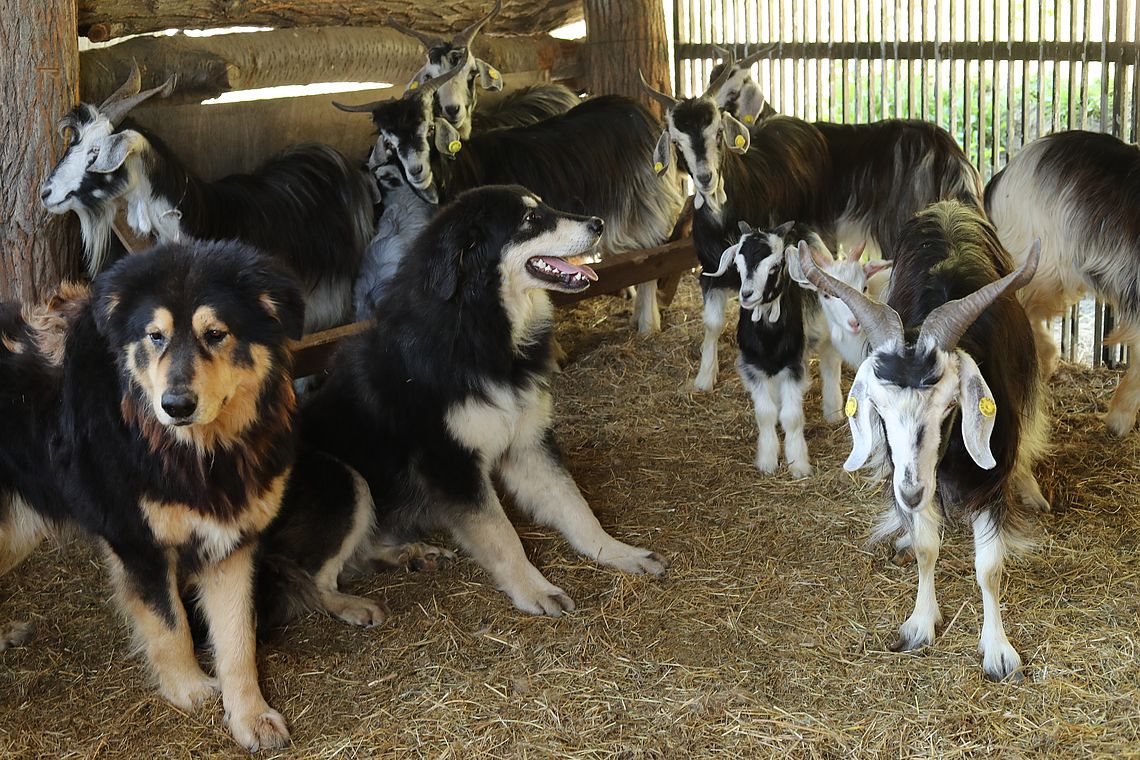
Protecting a herd of goats is one of the most complex challenges of modern extensive farming. Goat farmers discover this early on: these animals have completely different behaviors than sheep. They are curious, intelligent, independent, and extraordinarily adaptable to their surroundings.
A goat doesn't easily stay in a compact herd. It moves, explores, climbs slopes, enters bushes, and constantly seeks out new plants to graze on. This behavior makes goat farming ecologically interesting, but it also creates new challenges in protecting livestock.
When the herd disperses across the landscape, it inevitably becomes more vulnerable to predation.
And it is precisely in this context that one of the oldest alliances between man and animal comes into play: the livestock guardian dog.
It's not simply a dog that lives with the flock.
It's an animal selected to play a specific role in the balance between livestock, the landscape, and wildlife.
A good livestock guardian dog isn't just a defender.
It's an interpreter of the landscape.
The Ancient Alliance Between Shepherd and Dog
For thousands of years, humans have used dogs to protect livestock. This relationship originated long before modern farming techniques and represents one of the most natural and effective defense systems ever developed.
The livestock guardian dog is neither a hunting dog nor a herding dog.
Its job is not to chase a predator.
Its job is to prevent an attack from occurring.
This occurs through a combination of behaviors:
- territorial presence
- constant vigilance
- warning barking
- territorial patrolling
- direct defense only when necessary
A predator, which in nature always tends to minimize risks, almost always prefers to avoid a confrontation with a large, confident animal.
In other words, the livestock guardian dog functions primarily as a deterrent.
Why Goats Are More Difficult to Protect
Many farmers with experience with sheep are surprised when they start raising goats.
The reason is simple: the behavior of the two animals is profoundly different.
Sheep have a strong tendency toward cohesion. They stay close together and often move as a single unit.
Goats, on the other hand, are more exploratory animals. The group easily divides into small subgroups that use different portions of the territory.
This creates some specific challenges for the livestock guardian dog.
The dog cannot simply stay in the center of the flock. It must be able to:
- monitor the edges of the pasture
- observe the nearby woods
- monitor access points to the territory
- maintain contact with the animals
In practice, the dog must develop true territorial intelligence.
Qualities of a good goat dog
Not all livestock guardian dogs function the same way on goat farms. The most important qualities are behavioral.
Mental stability: The dog must be self-confident, balanced, and not impulsive. An overly nervous dog creates stress in the flock.
Strong attachment to livestock: The dog must live naturally close to the animals and consider the flock part of its social group.
Observation skills: A good livestock guard dog spends a lot of time observing its environment. It not only reacts to obvious stimuli, but also perceives changes in the environment.
Hardy: Life on pasture requires great endurance. The dog must tolerate heat, cold, rain, and long periods outdoors.
Autonomy: The dog often works far from humans. It must therefore be able to make independent decisions.
The myth of the gigantic dog
In the collective imagination, the livestock guard dog is a huge and impressive animal.
The reality of the job is different.
Size is useful, but it is not the only determining factor.
A dog that is too heavy may have difficulty moving in mountainous or wooded environments. In complex terrain, agility often becomes more important than bulk.
The ideal goat dog must be:
- robust
- resistant
- agile
- capable of continuous movement
The true strength of a guard dog is not just physical.
It is above all behavioral and mental.
The Maremma Sheepdog
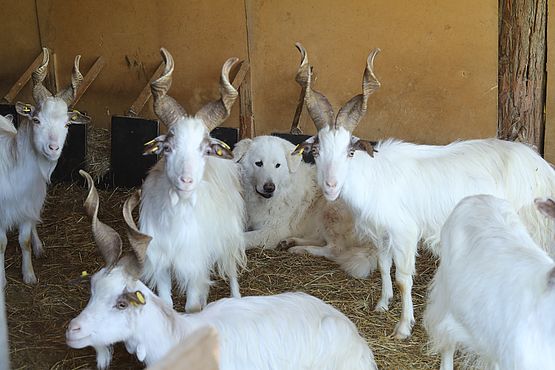
Among Italian livestock guard dogs, the Maremma Sheepdog is probably the best-known.
For centuries, it has accompanied flocks and herds along the Apennines, protecting livestock from wolves and other predators.
It is a dog with a strong territorial presence.
Its mere presence often deters many predators.
The Maremma Sheepdog is particularly effective when working in a group with other dogs. In these situations, it can create a veritable protective barrier around the flock.
In goat farming, it can be extremely effective, especially in areas with high predator pressure.
The Sila Sheepdog
In recent years, another Italian breed historically linked to livestock protection has been rediscovered: the Sila Sheepdog.
This dog combines a robust build with remarkable agility.
In goat farming, this characteristic can be very valuable.
Goats often use complex terrain: steep slopes, rocks, woods, and dense vegetation. In these environments, an agile dog can better control the territory.
The Sila Sheepdog tends to move with great order and continuity, patrolling the edges of the pasture and observing the surrounding area.
Why many livestock guard dogs don't work
One of the most important things to understand is that not all livestock guard dogs actually work.
Many breeders purchase a dog thinking that the breed is sufficient to guarantee the protection of the flock.
In reality, the situation is much more complex.
The most common problems are:
- Dogs excessively attached to humans - A dog that constantly seeks contact with people tends to distance itself from the flock.
- Dogs raised without livestock - If the puppy doesn't grow up in contact with animals, it is unlikely to develop a strong bond with the flock.
- Non-functional selection - Many dogs today are selected primarily for their appearance and not for their working abilities.
- Poor management - Even a good dog can become ineffective if not properly introduced to the flock.
The most common mistakes breeders make:
Those who begin using livestock guard dogs often make some typical mistakes.
- Introducing the dog too late - The best time to introduce a dog to the flock is when it is still young.
- Isolating the dog - A livestock guard dog should not live separately from the livestock.
- Thinking that one dog is enough - Effective guarding almost always begins with a team of dogs.
- Not observing the dog's behavior - Every dog has a different personality. It is important to understand how it reacts to different situations.
How to Choose a Livestock Guarding Puppy
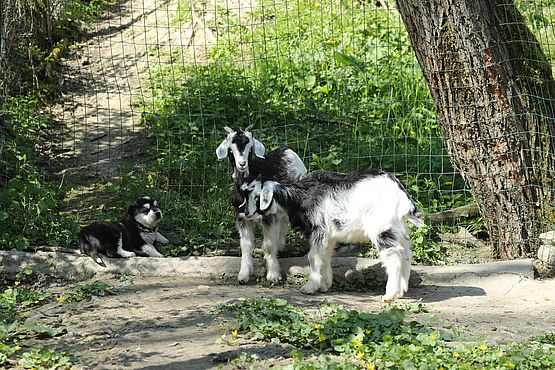
Choosing a puppy is one of the most important decisions you make.
A good puppy should come from lines selected for working with livestock.
It is important to consider:
- the behavior of the parents
- the environment in which the puppies are raised
- their relationship with animals
A puppy raised around livestock naturally develops a bond with them.
The Importance of Adult Dogs
Adult dogs play a fundamental role in the development of young dogs.
Puppies learn a lot by observing the behavior of more experienced dogs.
This natural learning process allows young dogs to gradually develop the skills necessary for guarding.
Guarding is a System
A guarding dog is not a magic solution.
It works best when part of a well-organized management system.
This system includes:
- Proper pasture management
- Presence of the breeder
- Good fencing
- Animal health checks
- Adequate number of dogs
When all these elements work together, the safety of the farm increases dramatically.
The right dog for goats
In the end, the question remains the same: what is the best dog to protect goats?
The answer isn't simply a breed name.
The best dog is the one that can:
- Stay close to the flock
- Read the territory
- Maintain a balance between calm and determination
In many farms, the Maremma Sheepdog is an excellent choice due to its strength and deterrent ability.
In other contexts, the Sila Sheepdog can offer a very interesting combination of agility and mobility.
The real difference always comes from the coherence between dog, territory, and husbandry system.
When this combination works, something simple but fundamental happens.
The goats graze peacefully.
The predator keeps its distance.
And the farmer can finally work with peace of mind.