
The protection of poultry is, without a doubt, one of the most complex challenges for a guardian dog. Unlike flocks of goats or sheep, chickens and ducks move quickly, unpredictably, and can become easily agitated—traits that require the dog to have a very high level of self-control and uncommon maturity. However, when properly managed, the presence of a dog in the farm can greatly enhance the welfare and safety of the animals, especially in organic or free-range farming systems.
One of the most important aspects concerns the age at which the dog is introduced to the poultry house. Puppies between five and seven months go through a phase of exuberant and often chaotic play, which can cause chickens to flee or flap their wings, triggering in the young dog an immature predatory instinct that is difficult to control. What starts as a simple chase game can, over time, turn into real predation. For this reason, it is recommended to introduce the dog to the poultry house no earlier than one year of age, when it has reached a sufficient level of emotional balance and greater ability to manage stimuli.
For the protection of poultry, the Maremmano Sheepdog is preferable to the Silano, although the key aspect is temperament: the dog intended for poultry must be calm, thoughtful, not hyperactive, and accustomed to maintaining composure even in the presence of sudden movements. A good poultry guardian observes, monitors, and protects without being carried away by the excitement of the flock.
If the dog shows the first signs of the chasing game, it is necessary to intervene immediately and decisively, interrupting the behavior and correcting it at the outset. Consistent and firm guidance allows the dog to understand boundaries and develop a proper relationship with the animals it is meant to protect. If, despite interventions, the tendency to chase frequently recurs, it is likely that the dog is not suitable for this type of work.
When the right dog is identified and a gradual, well-guided integration is established, the result is extraordinary: a reliable and silent guardian, capable of keeping chickens, ducks, and other poultry safe, significantly improving both security and the daily harmony of the farm.
Technical-descriptive report on the use of guardian dogs for the protection of free-range poultry
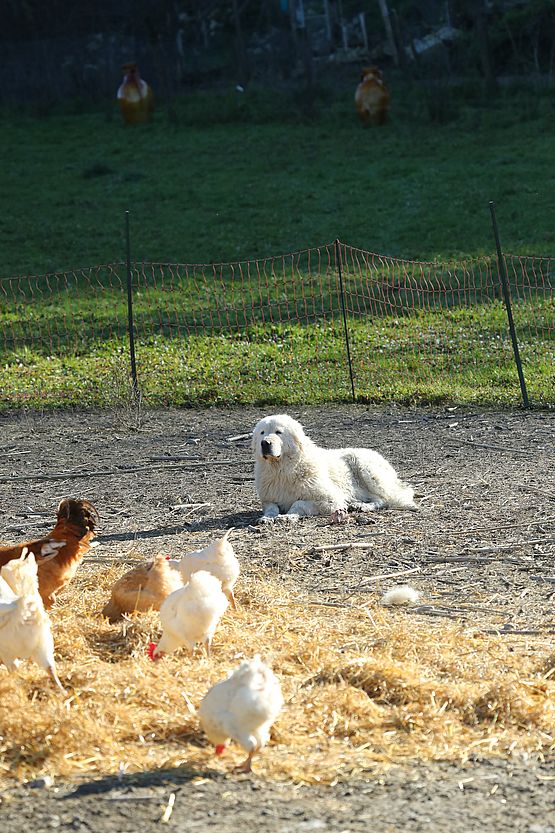
Protection for laying hens in a free-range farm can provide a useful perspective on how to improve the safety and efficiency of such agricultural enterprises, especially in the presence of previous losses like those experienced by the Vuerich Farm. This report examines the role of guardian dogs in increasing the protection of hens from external risk factors.
Introduction
Free-range laying hen farms allow animals to move freely outdoors, offering them a more natural life and improving the quality of the eggs produced. However, this freedom exposes hens to greater risks, particularly from predators. In the face of past losses due to predators such as foxes, martens, hawks, or other wild animals, it is necessary to adopt effective protective measures. The introduction of guardian dogs is an increasingly considered solution for these purposes, although their adoption in Italy has not reached expected levels, due to suboptimal practices in relying on this form of active defense.
The Role of Guardian Dogs
Guardian dogs are bred and selected specifically to defend flocks or herds from predator attacks without harming the animals they protect. The most suitable breeds for this role include the Maremmano-Abruzzese Sheepdog. These dogs possess a strong protective instinct and are able to establish a good bond with hens, treating them as co-inhabitants of their territory, represented in this case by the chicken coop and the fenced daytime pasture area.
Advantages of Guardian Dogs
- Affective deterrent: the mere presence of a guardian dog can discourage predators from approaching the hen area;
- Continuous protection: unlike passive measures such as fences or nets, dogs provide active and continuous protection, often even at night when many predators are most active. In our experience, nighttime confinement of poultry could even be avoided;
- Long-term costs: although the upkeep and care of dogs involve expenses, these costs are generally offset by reduced losses of hens and increased egg production;
- Animal welfare: having guardian dogs reduces stress in hens, resulting in better overall health and productivity. Even the organoleptic quality of the eggs improves significantly, given the low cortisol levels in the blood.
Practical Considerations
Before introducing a guardian dog into a farm, some considerations are essential:
- Breed selection: choose the dog breed suitable for the climate, type of predators present, and hen behavior;
- Training and socialization: ensure the dog receives proper training and acclimation to work with hens without causing stress or harm;
- Supervision: in the initial stages of introduction, dogs should be closely monitored to ensure correct interactions with hens.
Conclusion
The adoption of guardian dogs in free-range laying hen farms represents a promising strategy to mitigate predation risks. This measure not only increases the safety of hens but also contributes to the overall welfare of the animals and the economic efficiency of the farm. With proper preparation and consideration, guardian dogs can become an indispensable element for the security of free-range farms.
Strategic Implementation of Guardian Dogs in the Farm
Selection and Training
In our farm, dogs selected to protect laying hens come from genetic lines with a long history of working with other farm animals, such as sheep, alpacas, and goats. This heritage gives the dogs an innate and refined ability to manage various types of animals—a critical factor in their role as guardians of hens. In particular, the last two generations of dogs have been specifically trained to work with hens, ensuring an appropriate and gentle approach to these birds.
Management of Gender Dynamics
To prevent internal conflicts that could disrupt the farm environment, introducing mixed pairs of dogs is recommended. Competition between males of the same sex, which can lead to aggressive behavior, is well known and must be carefully managed. Therefore, we recommend pairing a male with a female. The male also plays a key role in territorial marking, which is crucial to keeping predators away.
Ensuring Reliability
The dogs provided to Vuerich Farm are exemplary of this practice. They have been tested and have demonstrated reliability in our farm enclosures, coexisting peacefully and protectively with a variety of animals, including other poultry such as geese in addition to hens. This experience confirms the adaptability and safety of dogs in a multi-species farming context.
Conclusion
The targeted and conscious use of guardian dogs in free-range farms not only improves the safety of laying hens but also the sustainability and efficiency of the farm itself. Careful selection of dogs based on pedigree and prior experience, along with informed management of gender dynamics, ensures a serene and productive environment for all species involved.
Analysis of Training Approach
Issues with Early Imprinting
Attempts to use early imprinting, similar to what is done with sheep, to integrate puppies with hens have shown significant limitations. Experience has demonstrated that puppies exposed directly to hens between 3 and 5 months can develop predatory behaviors. This occurs because, during this developmental stage, the dog is forming the foundations of its predatory behavior. The stimulating presence of hens can trigger these instincts rather than suppress them.
Recommended Integration Method
Based on our experience, puppies are raised in an environment that includes hens, but without direct contact until they are at least one year old. This allows dogs to become accustomed to the presence of hens without stimulating predatory behavior. Introducing adult dogs that have already demonstrated non-predatory behavior toward hens is the preferred approach. This method allows for better assessment of the dog’s individual adaptability and risk mitigation.
Results and Effectiveness of Protection
Successes
The results obtained are remarkable: complete elimination of predation by terrestrial predators such as martens, mustelids, and foxes in all cases where our dogs were used. Protection against diurnal birds of prey such as hawks and goshawks is between 75% and 85%, demonstrating a high level of effectiveness even against aerial threats.
Limitations
The only predator that seems to evade the dogs’ protection is the Eurasian eagle-owl, which is primarily nocturnal. This limits the effectiveness of protection due to the owl’s ability to move undetected and its predominantly nighttime activity, when dogs may not be fully alert or effective in perceiving this specific threat.
Conclusions and Recommendations
The approach we have developed for integrating guardian dogs with laying hens shows remarkable success and should be considered as a model for similar farms facing comparable challenges. Choosing adult dogs already tested for non-predatory behavior is the safest and most effective strategy. It is essential to continue monitoring and adapting training and integration techniques based on continuous feedback and best-practice research in the sector.
Sincerely,
Dr. Dario Adolfo Capogrosso