Who I am: Dr. Dario Capogrosso
Professional breeder, zoonomist, dog consultant, and founder of the ENCI-FCI affix "Pastore Transumante"
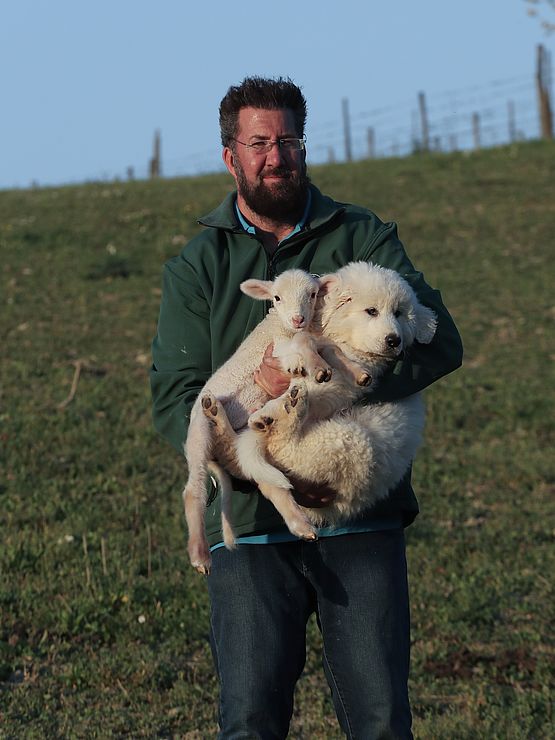
My work stems from a profound conviction: breeding means protecting biodiversity and preserving the millennia-old history of livestock guarding breeds. I am inspired by the values of the Maremma-Abruzzese Shepherd Club, which has always promoted genetic improvement, valorization, and use of the Sheepdog in harmony with its original purpose.
"Our task is to preserve a unique genetic and cultural heritage, protecting it for future generations."
A journey through nature, research, and passion
- Active WWF Member since the 1980s
- Breeder and breeder of canaries and finches since 1993, with awards and articles in Italia Ornitologica
- University studies in: Veterinary Medicine – Milan (Animal Production)
- Van Hall Institute – Netherlands (Wildlife Conservation and Wildlife Area Management)
- International experience with leading breeders and industry professionals, including the legendary Varenne trainer, Jori Turija, from whom I learned the best equine management techniques.
Association and Leadership Experience
I have developed strong organizational and management skills as:
- President of the Erasmus Student Network Milan
- National Representative of ESN Italy
I have promoted projects with a European scope, developing networking and innovation skills.
Dog Breeding and Specialization
- Active CPMA member since 2007, former President of the Northern Delegation
- ENCI-FCI affix "Transhumant Shepherd," with a selection of Italian livestock guard dogs
- Collaboration with Italian, European, and international breeders
- Dog Nutrition Consultant (in partnership with Vema Pet Food Italia)
- Camelid Nutrition Expert: creator of the first supplementary pelleted feed in Italy
Titles and Certifications
✔ ENCI Master Breeder (2013)
✔ FICG Guard Dog Consultant (2014)
✔ FICG Federal Inspector (2015)
✔ CISCAL Wolf-Anti-Wolf Training Technician (2015)
✔ Natural Dog Breeding Consultant (2016)
✔ Co-founder of the Natural Dog Breeding Institute (2016)
(Pending appointment as International Alpaca Judge for the British Alpaca Society)
Role in the alpaca and camelid world
- Vice President of the Italian Alpaca Society (responsible for communications and member relations)
- Founding member of SNAEL (National Alpaca and Llama Society)
- First kennel in the world to unite alpacas and livestock guardian dogs: Alpacando.
Commitment to the breed and the local area
- Participation in CPMA meetings and conferences
- Creation of a morphological evaluation sheet and BLUP model
- Collaboration with regional projects in Piedmont and Liguria for the inclusion of livestock guardian dogs
- Search for sponsorship and promotion of breed events
- Spreading the culture of livestock guardian dogs, with educational activities in schools and local authorities
My philosophy
"A breeder is not just a breeder: he is a custodian of history, genetics, and culture."
An organic system for coexistence, animal husbandry, and the future of farms
Programmatic letter of vision and method
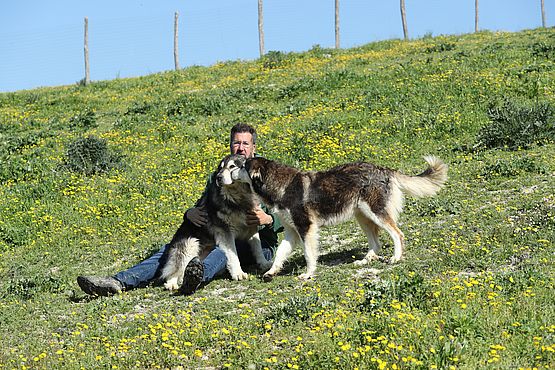
The Pastore Transumante, home to Italy's first Canine Biopark, is a project that, by conscious choice, does not fit into conventional breeding models.
We are not a traditional breeding facility, and we are not so in method, vision, or responsibility. We are a Canine Biopark and a center for the selection, functional breeding, and training of guard dogs and working dogs, active for over fifteen years in the real-world training of dogs for livestock husbandry and multispecies protection.
The project was conceived and is led by the undersigned, Dr. Dario Capogrosso, a technician with a degree in Animal Production Sciences and Technologies from the Faculty of Veterinary Medicine, and a Master's in Wildlife Conservation. Therefore, it is not an empirical or commercial initiative, but a model founded on scientific expertise, ongoing study, and field-based livestock application.
Over the years, we have progressively specialized in guarding, becoming the largest Italian center dedicated exclusively to this field and one of the very few real references in Europe.
The Dog Biopark is not simply a physical place. It is, first and foremost, a method.
It is not a container for animals, nor a collection or an exhibition. It is a complex biological system, designed to connect in a functional, controlled, and replicable way:
- dogs,
- farmed animals,
- the environment,
- humans,
- biodiversity.
The facility extends over approximately 40 hectares and was built in full compliance with local health authority regulations and biosecurity protocols, using functional fencing, targeted separations, sanitary containment systems—including underground ones—and minimal biological risk control.
In our system, dogs are never isolated. We believe that structured socialization is the foundation of ethological well-being and functional competence: a socially competent dog is never a problem.
Our method is based on a key principle: from talent to function. We don't force dogs into pre-established patterns. We observe them, guide them, recognize and enhance their individual aptitudes. We start with their original genetics, selected for competence and stability, and accompany each dog from birth, throughout their growth, until full ethological maturity.
For this reason, our guard dogs are not sold as puppies, but between two and three years of age, when they are mentally mature, emotionally stable, and ready to face complex real-world situations. We work on epigenetics, direct experience, and the transmission of skills, not on artificial training. Our dogs don't learn to guard: they live by protecting.
One of the distinctive elements of the Bioparco Cinofilo is real, not theoretical, multi-species guarding. Our dogs grow up and work in contact with horses, donkeys, goats, alpacas, and poultry, and eventually also with llamas, cattle, and pigs raised on extensive farms. This is a crucial point, as traditional systems for introducing puppies to alpacas and poultry have historically resulted in failures, generating predation, stress, health problems, and ethological incompatibilities.
In our system, we achieve consistent and measurable results because the dog is introduced only after the first year of age, when the dogs are already structured, have outgrown their predatory phase, and are able to learn the language of the different species. In these contexts, the livestock guard dog becomes not only a defense against predators, but also an effective means of health biocontainment, capable of reducing the approach of wild fauna, limiting the risk of contamination, and protecting open-air farms.
Our goal is not to "produce dogs," but to create balance between species. We protect animals, farms, production chains, territories, and ethological breeding models. In our system, the guard dog is a true biological infrastructure: it doesn't pollute, it doesn't consume resources, it doesn't generate conflict, but it creates stability.
Unlike a conventional breeder, we don't sell puppies, we don't outsource work to clients, and we don't promise future results. We control the entire working dog process: from genetic selection to growth, from preparation to guided introduction, and even long-term support.
The Bioparco Cinofilo is also a wealth of applied scientific and zootechnical knowledge, a place where animal husbandry becomes compatible with biodiversity, and coexistence is not an abstract concept, but an operational reality.
It is a dynamic system, constantly evolving, because reality changes. Thanks to a widespread network of breeders and farms, we constantly collect field data that allows us to monitor the evolution of predation and predator behavior. What worked five years ago is no longer sufficient in many contexts.
Our experience shows that the most effective solutions today lie in already structured dogs, whether puppies or adult dogs, socialized and manageable, capable of maintaining deterrence without generating conflict with people and the territory. A dog that is properly cared for, supported, and integrated is not a problem, but a resource.
The major limitation of the current system is often the disconnect between theory and practice: between those who write protocols and those who actually produce functional dogs. Our goal is to bridge this gap and become a regional and national reference point for the correct, up-to-date, and responsible use of guard dogs.
The Bioparco Cinofilo doesn't require space. It offers solutions.
In a Europe that speaks of ecological transition, animal welfare, and coexistence, this model isn't an option: it's a structural necessity.
Sincerely,
Dr. Dario Capogrosso