The dog does not protect for free: the flock is a resource
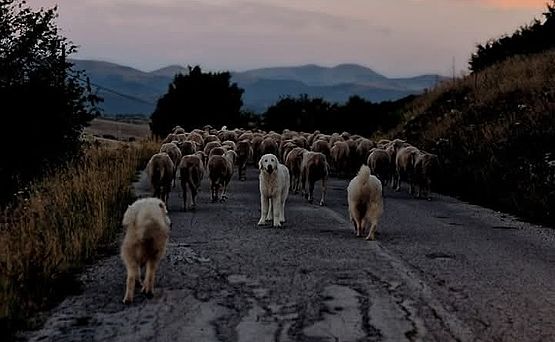
The bond between livestock guardian dogs and sheep is probably the oldest, most stable, and biologically sensible of all forms of human-dog-domestic animal collaboration.
- It does not arise from affection.
- It does not arise from training.
- It arises from mutual convenience.
The livestock guardian dog serves the flock, yes—but not in a moral or "noble" sense.
It serves the flock because the flock is its resource.
The dog does not protect "for free."
The dog does not protect the flock out of "love," but because it benefits from it. The dog that lives within the flock system derives direct and indirect benefits from it and defends what guarantees its survival.
We're talking about nutrition, such as placentas, feces, carcasses, biological waste, and the constant odor of live ungulates. For example, at lamb birth, the placenta is:
- high in protein
- rich in fat
- biologically "safe" (it is part of the natural cycle)
The dog that lives permanently with the flock knows that this moment brings food and that that food is linked to the survival of the sheep.
Protecting the pregnant ewe = protecting a future resource.
This is not training.
It is both natural and cultural selection.
The bond between sheepdogs and sheep flocks: a functional, not symbolic, relationship
The bond between sheep and sheepdogs is often described in a romantic or simplified way, as if it were the result of careful training or a particular "kindness" on the part of the dog. In reality, it is probably the most obvious, stable, and functional interspecific relationship that humans have ever built in the livestock world.
Dogs and sheep are not a casual pairing. There is a profound affinity, born not from affection but from mutual ecological convenience. The livestock guardian dog is not an external entity that "defends" the flock: it is part of the flock system.
To say that the dog is "at the service of the flock" is correct, but only if we clarify that this is not a moral or obedient service. It is a functional service. The dog protects what keeps it alive.
The dog does not protect for free: the flock is a resource.
The livestock guardian dog lives within the flock and benefits directly and indirectly from it. This is a truth often silenced because it is incompatible with a sugarcoated narrative of the human-animal relationship, but it is central to understanding why livestock guardianship works.
Sheep provide dogs with:
- territorial continuity
- social stability
- constant olfactory cues
- indirect food resources
These resources include biological elements such as placentas, feces, carcasses, and natural waste, which are part of any effective pastoral system.
During the lambing season, the placenta represents a highly immediate source of energy. A dog living permanently with the flock quickly learns that the survival of pregnant ewes and lambs is directly linked to the continuity of this resource. Defending a sheep is therefore not a symbolic act: it is a strategy for preserving the system on which it depends.
Even the occasional consumption of sheep feces, often stigmatized, should be viewed as an opportunistic and adaptive behavior, not as a pathology. In extensive rural environments, feces represent an organic residue rich in microorganisms and secondary nutrients. A dog raised in the flock recognizes it as part of the environment, further strengthening the functional bond with the animal that produces it.
Similarly, the dog clearly distinguishes between a living animal and a dead one. A carcass is not a "sheep," but a resource. This aspect is consistent with what Raymond Coppinger and Lorna Coppinger described: in livestock guardian dogs, the predatory sequence is interrupted, not absent. They neither chase nor kill, but know how to consume what is already dead without confusing roles.
Defending the flock means defending oneself.
The livestock guardian dog does not defend the sheep because he "loves" them, but because their survival guarantees his own. This is the central point that distinguishes real livestock guardianship from its modern imitation.
A predator that steals animals from the flock:
- reduces the availability of resources
- destabilizes the system
- puts the territory at risk
The dog reacts not out of heroism, but out of evolved self-preservation. The flock represents home, food, continuity, and a social role. Protecting it means keeping intact the balance of which the dog itself is a part.
When man breaks the balance, the dog gets lost
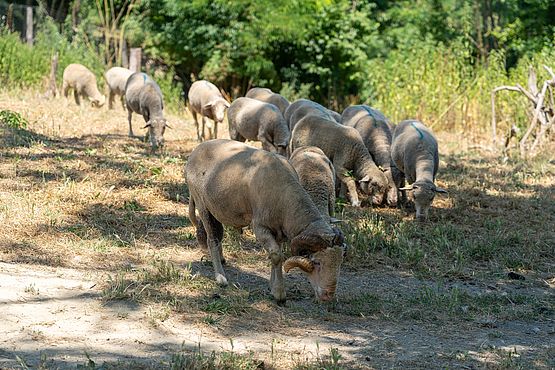
Many problems attributed to livestock guarding dogs arise not from the dog's errors, but from the artificial disruption of this system. Forced separations, excessively compartmentalized enclosures, completely unrelated feeding, late or symbolic introductions into the flock: all of this creates confused, hyperterritorial, or ineffective dogs.
When the dog no longer derives any real benefit from the presence of the sheep, protection becomes:
- mechanical
- intermittent
- unstable
A dog that lives next to the flock but not within it does not develop the same reliability. The functional bond is lost, and with it, true guarding.
Success does not depend on a single factor, but on a complex system.
The success of a livestock guarding dog is never automatically guaranteed. It does not depend solely on the breed, nor solely on the individual, nor solely on the breeder's will. It depends on a combination of interconnected factors, and ignoring even one of them compromises the entire balance.
The first element is obviously the dog: genetics, functional selection, individual temperament. A dog born from true guarding lines, raised in a coherent environment, has a completely different predisposition than one "reconverted" or selected for other purposes. But this alone is not enough.
How the dog is raised in the first months of life is crucial. A dog raised in isolation, without animals, without consistent stimuli, without a true imprinting, will leave behind a void that is difficult to fill later. Conversely, a dog raised in the presence of animals from a young age, even gradually, builds a mental map of its role before even having to "perform" it.
Insertion into the new context is crucial.
Another critical step is where and how the dog is introduced when it arrives at the new kennel. It makes no difference whether the dog enters:
- into an already structured environment
- into a stable flock
- or into an environment without animals, only to be "added" later.
Introducing a dog into a place without animals means asking him to wait, to suspend his role, to adapt to a void. This often generates hyper-territoriality of space, difficulty recognizing the flock as a reference point, and incorrect control behaviors.
On the contrary, direct or gradual introduction into the presence of the flock immediately gives the dog a sense of purpose: the territory, the animals, the smells, and the dynamics immediately become part of his world.
Not all sheep are the same
An often overlooked aspect is that the flock also matters, and matters a great deal. Sheep are not a passive element of the system.
For example, southern sheep breeds, historically accustomed to predatory pressure, tend to stay together, "mòrria," move as a group, and not disperse easily.
This behavior is a huge advantage for the livestock guardian dog. A flock that moves cohesively:
- is easier to control
- emits clearer signals
- allows the dog to position itself correctly
On the other hand, flocks that fragment, disperse, or move chaotically pose difficulties for even the most capable dogs, because they force the dog to constantly choose who to protect and where to stay, increasing stress and the possibility of error.
The system comes before the individual
When livestock guardianship fails, too often the dog is blamed. In reality, in most cases, the problem is systemic:
- the right dog in the wrong context
- an unsuitable flock without management
- poor introduction
- unrealistic expectations
The livestock guardian dog is not a tool that turns on. It is a living element of a livestock ecosystem. It works when all the pieces are consistent: genetics, breeding, introduction, type of flock, territory.
In summary
True guarding isn't the result of a single gesture, but of a process built over time. Where the system is coherent, the dog becomes reliable almost without human intervention. Where the system is fragmented, even the best dog in the world can fail.
Increased predatory pressure
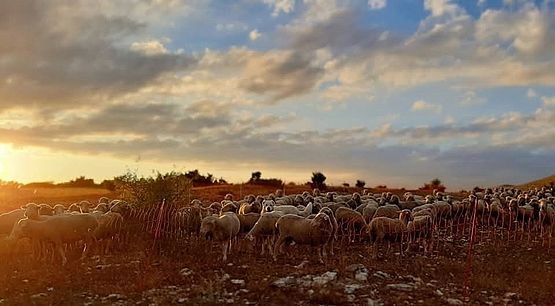
In recent decades, the context has changed radically. The impact of predation in Europe has increased dramatically, not only in numerical terms but above all in strategic terms. Predators, especially wolves, are not simply "more": they prey better, over larger territories, with increasingly refined patterns.
This evolution did not happen by chance. It is also the direct result of our choices. In the process of exporting and replicating historical models from central and southern Italy to the north, we lost fundamental parts of the system. We took the concept, but not the entire cultural and operational framework that supported it.
In many cases, only a few dogs were introduced, young or immature dogs, or dogs not truly selected for guarding, or isolated dogs without a pack structure.
This has produced a paradoxical effect: not deterrence, but learning for the predator.
Today's wolf knows the limits of our protections
The modern European wolf is no longer naive; its predation behavior has also evolved. It has learned to assess the actual number of dogs, to distinguish young dogs from adults, to recognize unmotivated or isolated dogs, and to elude fences and static systems.
In many contexts, poorly integrated guard dogs are no longer scary. Not because the dog has lost its value, but because the model has been impoverished.
Where the dog offers little deterrence, the wolf does not retreat: it observes, studies, and waits. And when it identifies a favorable window, it strikes. In this scenario, guarding can no longer be thought of as a simple symbolic presence, but as a structured, active defense.
The Limits of Puppies in the Current Context
Another serious mistake, often repeated, is thinking of introducing puppies into contexts with high predator pressure. Today, in many European areas, this is no longer possible.
The wolf has become accustomed to taking pups, eliminating them before they become a problem, interrupting the growth and imprinting process.
Introducing puppies means exposing them to a real risk of death. It's not just an ethical issue, but an operational one: a dead dog protects nothing.
For this reason, in high-predation pressure environments, we must work with fully trained adults, dogs that:
- have a physical structure
- have experience
- know how to live in a flock
- are capable of immediate reaction
The puppy can only regain its meaning later, as reinforcement, support, generational continuity, and never as a first line of defense.
From symbol to strategy
Today we are no longer in the romantic phase of coexistence. We are at the stage where guarding must return to being a zootechnical strategy, not a theoretical project. This means fewer "fake" dogs and more truly functional dogs, less improvisation and more understanding of the territory and the predator.
The guard dog remains an extraordinary tool, but only if it's part of a comprehensive system, consistent with the current level of predator pressure. Where this isn't the case, it's not the dog that fails: the model fails.